Do-Gooder Consulting Homepage

Showing posts with label College Financial Aid. Show all posts

Thursday, October 1, 2020

FAFSA begins TODAY (Free Application for Federal Student Aid)

It's FAFSA Time! For those of you just getting back into this, the FAFSA opening day has changed from January 1st of a high school student's senior year to TODAY, October 1st of that same high school student's senior year. That's 3 months earlier than in years past (and actually 6 months earlier than how families 20 years ago filled out the FAFSA).


The reason for this is so that new soon-to-be college students who are applying in the fall can almost immediately compare their options, especially if the final decision comes down to finances. Check our graphic at the bottom of this post so you can visualize how, in order to receive an official financial aid award, a student needs to have both an accepted college application as well as a processed FAFSA.


Do-Gooder Consulting is here to help organizations plan, advertise, or even run a FAFSA completion session. Please contact us by phone at 872-222-8008 or by email at FAFSA(at)do-gooder.us or call us at 872-222-8008 .

We look forward to serving you in the near future.


One final note: please encourage your current college students to renew their FAFSA as soon as possible. It's easy to forget, but with the renewal using the same information they just inputted 6 months ago, it's also easy to fill out, and could provide more money than last well. Simply text and/or e-mail them this secure website address = www.FAFSA.gov


In fact, we'd suggest contacting the following people to fill out the FAFSA as soon as pssible after October 1 (as it costs no money to fill out the FREE Application for Federal Student Aid):

1) Returning college students (see above)
2) High school seniors (as mentioned above)
3) Adults simply thinking about returning to college. Filling out the FAFSA does not obligate someone to go to college, but is one vital step in getting an official financial aid package.


Monday, September 26, 2016

FAFSA opening date change can HELP your organization help students!


We talked about this major change with the FAFSA (FREE Application for Federal Student Aid)  in a  previous post. As we have reported on this blog several months ago, the FAFSA opening day has changed from January 1st of a high school student's senior year to October 1st of that same high school student's senior year. That's 3 months earlier than in years past (and actually 6 months earlier than how families 20 years ago filled out the FAFSA)

The reason for this is so that new soon-to-be college students who are applying in the fall can almost immediately compare their options, especially if the final decision comes down to finances. Check our graphic at the bottom of this post so you can visualize how, in order to receive an official financial aid award, a student needs to have both an accepted college application as well as a processed FAFSA.

While this is perhaps a little confusing for many families right now, this is also a great opportunity for churches and nonprofits to provide leadership and resources to their community. By helping families fill out the FAFSA early, you and your organization may be able to provide them with thousands of dollars and financial aid without the organization itself needing to contribute towards that purpose. You also build trust in the community, and show one reason why you are a key community resource.

We see this as a great outreach because it's a very strong need for our families. Churches and nonprofits which are located near schools have an excellent opportunity for outreach and connecting with their local community. Churches can schedule a session right after their church service, and if possible, even provide lunch. Or, if it's possible , providing an afterschool or evening program with a light dinner, such as pizza, which can also be a huge benefit two families. Nonprofits as well can help their community and also their schools as well with an activity that helps families but let's the school clothes on time we be greatly appreciated by the local school.

Do-Gooder Consulting would like encourage you to start your plan this is possible. We understand it might be too late for you to start any event in October, but we encourage you to set up a session in November, December or even the first week of January (before current college students return to school) , and then plan for a FAFSA completion session in early October of 2017.

We have also written in the past about how financial aid deadlines are shrinking, and the importance of having the FAFSA completed as soon pas possible after that opening date.   However, we believe that missing October of 2016 (despite it being the opening date) will be just fine  because for this first year, a number of students will still be getting used to this new date and you may be able to do late by a month or so. For the future, however, we strongly suggest that you schedule a fast the completion session as close to October 1st as possible.


Do-Gooder Consulting is here to help you plan, advertise, or even run a FAFSA completion session. Please contact us by phone at 872-222-8008 or by email at FAFSA(at)do-gooder.us or call us at 872-222-8008 .

We look forward to serving you in the near future.


One final note: please encourage your current college students to renew their FAFSA as soon as possible. It's easy to forget, but with the renewal using the same information they just inputted 6 months ago, it's also easy to fill out, and could provide more money than last well. Simply text and/or e-mail them this secure website address = www.FAFSA.gov


In fact, we'd suggest contacting the following people to fill out the FAFSA as soon as pssible after October 1 (as it costs no money to fill out the FREE Application for Federal Student Aid):

1) Returning college students (see above)
2) High school seniors (as mentioned above)
3) Adults simply thinking about returning to college. Filling out the FAFSA does not obligate someone to go to college, but is one vital step in getting an official financial aid package.
The new deadline helps you receive the financial aid award faster than previous years.

Tuesday, May 17, 2016

FAFSA opening date has changed to THIS October 1!


The FAFSA opening date has changed! "Traditionally" the opening date was January 1. But things have changed,

The main trouble will be for families who have returning students. They will think “Didn’t we just fill this out?”  And that feeling is justified, as it may have been 8 months or less when they filled out the FAFSA.  That is going to require a change in mindset. For years, Do-Gooder Consulting has advocated FAFSA completion sessions at the beginning of the year. We have worked with churches to do such a session following their service on the first Sunday of January.


Now, we encourage churches to hold such a session in October or if needed, November. Nonprofits can work with families with holding evening sessions, or also during the day if the families have Columbus Day or Veterans’ Day off.  It’s a huge shift in scheduling, and may conflict with other activities. But if going to - and graduating - college is a priority, then lifestyle changes need to be made.

So please, plan accordingly, so your student can get the best financial aid possible. If you are part of a church or nonprofit (or even business that wishes to maximize help for your employees, customers and their families), please contact us at Do-Gooder Consulting, and let’s see how we can work together for the best interest of students. We would be happy to help you organize a coalition of organizations to maximize resources and impact. Feel free to call or text Do-Gooder Consulting at 872-222-8008 or e-mail at  blog@do-gooder.us


Thursday, January 28, 2016

Your student needs to fill out the FAFSA -- NOW!!!


We at Do-Gooder Consulting really want to implore anyone with a student going to college - whether high school senior, returning student, or an adult even thinking about going to college - to fill out the Free Application for Federal Student Aid (FAFSA) NOW! Don’t wait! 


Back in our day, the FAFSA was filled out by hand. The financial aid officer also had to calculate by hand, which made the process long and strenuous. Any revisions would be equally as long , so it was suggested that students wait until taxes were done before submitting the FAFSA. That allowed families to make copies of tax forms, and provide accurate information. Financial aid programs like the Illinois Monetary Assistance Program (MAP) grant were able to provide money up until classes actually began.


However, technology, especially through the web and computers, has completely changed the process - for the better.  Using www.FAFSA.gov families can quickly input (and change) information.  Most people send their taxes in online, whether by using an application at home such as Turbo Tax, or going to a professional such as H & R Block, or even most independent accountants.  That information can then be easily downloaded via the IRS Retrieval Tool. That one click often replaces the photocopies and mailings and calls to the financial aid office of the past.


The downside of the technology upgrades is that since it makes it easier to fill out applications for financial aid, more people know about the opportunities and are rushing to take advantage of it.  We talked about the shrinking MAP deadlines in the past. Even though the state of Illinois is having problems now with disbursing MAP funds for the current year, in order to possibly funds for the next school year (2016-2017), Illinois residents need to fill out the FAFSA within the next week.


We previously wrote about MAP deadlines, with 2015 running out by approximately Valentine’s Day (Feb. 14). Below is our projections for when MAP money will run out not just for the upcoming school year, but the school year following.


In looking at the graphic, you may have noticed that our projection for the end of MAP money is the middle of this November. That’s because of some major changes with the FAFSA for the next school year. Do-Gooder Consulting documented these changes in an earlier blog.

There are some good reasons for this change.  The earlier deadline, which now coincides with many college application deadlines. This allows students to make a timely decision to see if a college is a good fit not just academically but also financially. See our graphic below for details on the need to have both a completed FAFSA
and a college application that is not just completed, but accepted by the college.


The main trouble will be for families who have returning students. They will think “Didn’t we just fill this out?”  And that feeling is justified, as it may have been 8 months or less when they filled out the FAFSA.  That is going to require a change in mindset. For years, Do-Gooder Consulting has advocated FAFSA completion sessions at the beginning of the year. We have worked with churches to do such a session following their service on the first Sunday of January.


Now, we encourage churches to hold such a session in October or if needed, November. Nonprofits can work with families with holding evening sessions, or also during the day if the families have Columbus Day or Veterans’ Day off.  It’s a huge shift in scheduling, and may conflict with other activities. But if going to - and graduating - college is a priority, then lifestyle changes need to be made.

So please, plan accordingly, so your student can get the best financial aid possible. If you are part of a church or nonprofit (or even business that wishes to maximize help for your employees, customers and their families), please contact us at Do-Gooder Consulting, and let’s see how we can work together for the best interest of students. We would be happy to help you organize a coalition of organizations to maximize resources and impact. Feel free to call or text Do-Gooder Consulting at 872-222-8008 or e-mail at  blog@do-gooder.us

Thursday, January 21, 2016

Illinois College Access Network February 2016 meeting = Feb 9


Illinois College Access Network


Where?  Chicago Scholars – 247 S State Street – Chicago IL

When?   Tuesday, February 9, 2016

8:00 – Light Breakfast and Networking
8:45 – Onset of Mental Health Issues During the College Years
  • Coalition of 80 national private and public colleges (4 in Illinois) proposing innovative approach to processing applications
  • BRING YOUR OWN QUESTIONS AND CONCERNS
Announcements and additional discussion until adjournment +/- 10;30
Membership or Renewal:  www.illinoiscan.org.  Current members, categories, fees, and applications are at the website under “Membership.”

There are a lot of changes in the world of college access & financial aid. Come get updated!


You can also call/text 
872-222-8008 or e-mail blog@do-gooder.us for an update. Updates for the event are at this link and  the website at www.illinoiscan.org   


Tuesday, January 19, 2016

JP Paulus on V103 THIS Sunday

Do-Gooder Consulting President JP Paulus will be on V103's Sunday call-in show "Chicago Speaks with Darryl Dennard".

He should be on some time between 6:30pm - 7:30pm (depending on topics and guests) on Sunday, February 7.

You can listen by tuning into 102.7 FM, or online by clicking this link. V103 is part of the iHeartRadio network, and can be found on their app and website, if you'd like to listen online.

2 weeks ago, Chicago Speaks featured the MAP Grant crisis in Illinois, where the current state budget crisis is preventing the Illinois Student Assistance Commission from disbursing funds to colleges. Because of Chicago State University's current budget issues, the lack of MAP (Monetary Assistance Program) money is causing even larger problems, which is prompting quicker action.

That inspired JP to share his recent blogpost about 2016 MAP Deadlines and the new FAFSA opening date. Despite the current crisis, students will still have to plan for next year, as ISAC won't suspend their normal process. Also, the Free Application for Federal Student Aid (FAFSA) will have an earlier deadline.  JP will talk about those issues on this Sunday's show.

Now, breaking events could bump JP from the lineup, but plan to hear him some time between 6:30pm - 7:30pm

We hope you can tune in. You can also call in with questions at 312-591-8103.

Darryl M. Dennard, host of "Chicago Speaks" on V103, 102.7 FM in Chicago

.

Tuesday, September 22, 2015

FAFSA opening day has been moved up!

The US Department of Education is changing when families can begin filling out the FAFSA (Free Application for Federal Student Aid). "Traditionally", it has begin January 1 of the year the student begins fall semester. With the changes, that opening date is moved to October 1 (starting in 2017).

(see below for the full announcement.)

What does that mean?

Factually speaking, a student can fill out the FAFSA, and possibly get information on their financial aid eligibility for a college, almost 1 full year before they begin fall classes.

On the positive, financial aid packages can be created earlier, so that students can get a better idea of if they will receive financial aid at a particular school, or if they should apply for a different one (before those deadlines passes). Another possible positive may be that other financial aid forms , such as the CSS(which some private colleges require) may not be necessary. So possibly less paperwork, and less money (CSS charges a fee; FAFSA is always free, with it being the FREE Application for Federal Student Aid).

On the negative, financial aid deadlines will also be moved up, meaning things such as Illinois' MAP grant (worth up to $4700) will run out of money even sooner.

What you can/should do about it?

Plan to have a FAFSA completion service the first week of January. Whether it is on the actual holiday of New Year's, or the first Sunday, or during the week, the next round of financial aid won't begin until January 1, 2016.

Then immediately plan TWO big financial aid pushes for the following year. The first should occur near the first week of October 2016. Another alternative is to hold a FAFSA completion session on Columbus Day. Both Students and many parents should have that day off. Churches could hold their session on the holiday, or following their service on Sunday.


The second big push should continue to be either the first Sunday of the new Year, or starting in 2016, in December, when your returning college students are back as well.

See Do-Gooder's previous blog on planning a FAFSA completion session.

Here is the official announcement from the US Department of Education. They also have a PDF with FAQ's (Frquently Asked Questions) about this change.

Today, Monday, September 14, 2015, President Obama announced significant changes to the Free Application for Federal Student Aid (FAFSA®) process that will impact millions of students. We want to inform you—our partners in the college access, planning, and funding process—about these changes and provide you with tools and information you can use. 
Changes for the 2017–18 FAFSA®
(1)   (1) The 2016–17 FAFSA® will be the final FAFSA to launch on January 1.  Beginning with the 2017–18 application, the FAFSA will be available to students and families October 1 of the previous year. This means students who need to complete the 2017–18 FAFSA will be able to access and submit the form anytime from October 1, 2016, through June 30, 2018.
(2)   
(2)   (2) In addition to changing the launch date for the application cycle, beginning with the 2017–18 FAFSA, we also will change the requirements for reporting income information. Currently, FAFSA applicants are required to provide income information from the “prior year.”  For example, 2016–17 applicants must report 2015 income information.  Beginning with the 2017–18 FAFSA, applicants will be required to provide “prior-prior” year income information. This means that the 2017–18 FAFSA will collect 2015 income information. 
The following table provides a summary of key dates as we transition to using the early FAFSA submission time frame and earlier tax information.
When a Student Is Attending College (School Year)
When a Student Can Submit a FAFSA
Which Year’s Income Information Is Required
July 1, 2015–June 30, 2016
January 1, 2015–June 30, 2016
2014
July 1, 2016–June 30, 2017
January 1, 2016–June 30, 2017
2015
July 1, 2017–June 30, 2018
October 1, 2016–June 30, 2018
2015
July 1, 2018–June 30, 2019
October 1, 2017–June 30, 2019
2016
                                                                                                                              
Resources for You and Your Students
To assist you and your students in learning about these changes, the U.S. Department of Education and the White House have prepared several informational pieces (a fact sheet, FAQ, etc.). You can access some of them at FinancialAidToolkit.ed.gov/fafsa-changes now; and others will be added later today.
We will update the Financial Aid Toolkit and StudentAid.gov sites as the 2017–18 FAFSA launch approaches. Keep an eye out in spring 2016 for further resources such as talking points, suggested tweets and Facebook posts, etc.
 
Please know the President’s remarks which will be streamed live from Des Moines beginning at 4:40 p.m. ET at whitehouse.gov/live.
As always, we thank you for everything you do to advance equity in access to higher education for the nation’s students.


Federal Student Aid Outreach Team
830 First Street, NE
Washington D.C. 20202


===============

Do-Gooder Consulting is a consulting firm for churches, nonprofits, and small businesses. We provide coaching and teaching on issues relevant to the field, and aim to "help you help others." Please contact us at 872-222-8008 or blog@do-gooder.us to see how we can help you and possibly other partners get your students to college -- and then graduate.

Tuesday, February 3, 2015

Make sure your students fill out the FAFSA -- RIGHT NOW!!!


Your students need to fill out the FAFSA as soon as possible.

Last year, the state of Illinois' MAP grant ran out on February 28. Based on the infograph below we published last year, the 2015 deadline could be February 25 or earlier!


In the "old days" of the FAFSA, we were told to fill out the FAFSA after taxes were done. This was so because recalculating financial aid was done by hand, and so by giving estimated information created a lot of lot of work and time delay.

With the wonders of the internet and computer automation,  this process is much easier.

If you need help in this process, please contact Do-Gooder Consulting at 872-222-8008 or college@do-gooder.us


Wednesday, September 10, 2014

Plan your FAFSA Completion session now


In our previous entry, we talked about the why of filling out your FAFSA early (i.e. the first week of January).  With this post, we'd like to make some suggestions as to how, when and where to make these plans now, do you can be prepared later.
  

High schools are closed during winter break, yet the need exists. Your church or nonprofit could be a perfect location to complete the FAFSA.

If you are part of a church ministry, or have partnerships with churches, the first Sunday in January could be a GREAT opportunity to host a FAFSA completion event. We have written about that here. (We'll provide an updated entry in a few weeks)

What/who you need for a FAFSA completion session:
  • Computers - they can be desktops, laptops, or even tablets
  • Internet access, preferably wireless.  While wired internet access is fine for desktops, and laptops with appropriate cables, wireless would be better for devices owned by families (who might want that extra layer of privacy)
  • An expert on completing the FAFSA. Do-Gooder consulting can provide such an expert, with even a short Powerpoint presentation to cover common issues and concerns. If we are unavailable, we can coordinate with other experts to help you.
As to the when, here are some dates you might consider planning a FAFSA completion session

  • New Year's Day. This is the first day you can fill out the FAFSA for the 2015-2016 school year. While the morning might not be the best time (as people are recovering from New Year's Eve celebrations, the afternoon could work. Most parents have the day off, and could come to your facility.
  • The first Saturday after the New Year's. Many families will be available for a session.
  • On Sunday afternoon immediately after church, when most members are still in the building
  • Any weekday during the first week of January. Some families might work during this week, but some returning student and some working families might have
  • Martin Luther King Holiday. While this is a little later than we prefer, as of this writing, you can still beat most deadlines 


Just as a reminder of the importance of this planning, here's the graphic from our previous entry.


We can help you and your organization. We might be able to supervise a FAFSA completion session. If not, we can coordinate a session with experts who can help you during your desired sate. We will then follow-up to make sure the work of your families is completed, and they can receive the maximum financial aid.

Please contact us at Do-Gooder Consulting at 872-222-8008 or web@do-gooder.us to see how we might be able to help.


Tuesday, August 26, 2014

MAP Grants deadlines are shrinking

Why fill out the FAFSA on (or around) January 1, New Year's day?? Look at our infographic, followed by our explanation.


We have 4 dates listed, with 3 being approximately the same time every year:

  1. FAFSA (Free Application for Federal Student Aid)  is open on this date. This is always January 1.
  2. The Federal Tax deadline is almost always April 15 (with a couple of exceptions, usually April 16 or 17 at the latest)
  3. The first day of college (for many colleges on the semester system), approximate the 2nd Monday in August or so.
  4. The cut-off of the MAP grant. We will explain this below


In the"old days" of the FAFSA (back when the FAFSA was exclusive filled out on paper), we were told to fill out the FAFSA after taxes were done. This was because recalculating financial aid was done by hand, and so by giving estimated information created a lot of lot of work and time delay for the financial aid officers.

With the wonders of the internet and computer automation,  this process is much easier. Results can be done within days, if not hours (as opposed to several weeks "back in the day"). Verification can be done with a click of a button (where the FAFSA can verify info in the IRS database).

So now, you are not making it hard for financial aid officer to give you an award.

Because of the early submission of financial aid information, many grants and scholarships are running out of money much earlier in years past. Illinois, for example, offers the MAP (Monetary Assistance Program) grant, worth up to $4,800. For many years (even up to 2007),  this grant was available to some students even up to very close to start of school in August.  But over the years, that deadline has been pulled back. In just a few short years, that deadline was just before taxes were due on April 15.  This calendar year (2014), the deadline was February 28. For 2015 (a few months from now), that deadline could be even earlier.

Next time we'll talk about setting up a FAFSA completion event, with thoughts on how to best schedule it and who to partner with.

Please contact us at Do-Gooder Consulting at 872-222-8008 or web@do-gooder.us to see how we might be able to help.

Thursday, August 14, 2014

FAFSA PIN number will be phased out into a NEW system

The Department of Education (Ed) is phasing out the P.I.N. (personal identification number) for the FAFSA (Free Application for Federal Student Aid), which is used to access your FAFSA information.

Ed is replacing it with username/password setup in April of 2015. This is a major change in how students will be able to access their FAFSA...almost as big as the changeover form the paper FAFSA to FAFSA on the Web. Ed has stated that they are switching systems in order to provide more security for users.

The PIN will be used exclusively from now until March. 2015. This phase-out of PIN to Username/password for FAFSA applies to new (1st time filing out FAFSA in 2015) AND current.returning students.  So students who are currently in college, and will renew their FAFSA next year, will do so in the same way as they have before.

Students who will be filling out the FAFSA for the first time (such as current high school seniors who will enter college in August or September of 2015) will also use the PIN login system, but have to change over to the system.

Current high school juniors and others who will fill out the FAFSA after August 2015 (in most cases, starting January 1, 2016) will not use the PIN system at all, but rather the new username/password system. 

This new login system will not only affect your FAFSA login, but also other information regarding federal student aid, such as the NLDS (National Student Loan Data System) system for Student Loans. Note that this will not affect access to information on private scholarships, or private loans, which are not run by the federal government. Loans through Sallie Mae, Discover and other organizations will have their own login information.

If you are NOT currently a student, but have used the PIN for using FAFSA on the Web in the past, it is also recommended that you create a username and password as well, as you may still need to access information, such as on student loans.

More details on this transition are expected by February 2015.


Other information from their recent announcement included a change on parental information - FAFSA will focus on parents relationship with children.  So  it doesn’t matter if parents are married or not, same sex couple or not; all of this information will be used for FAFSA.

For more information on these and other changes, visit the Department of Education website for National Training for Counselors and Mentors (NT4CM) at www.Financialaidtoolkit.ed.gov/nt4cm

NT4CM is a comprehensive training program that delivers up-to-date information regarding federal and state student aid programs, scholarship searches, and financial aid fraud. Participants also learn how to access free resources such as fact sheets, brochures, and PowerPoint presentations that can be used in outreach to students. After the training, participants will receive ongoing information and support.


Do-Gooder Consulting provides an affordable year-long consulting service that includes 3 seminars (The Financial Aid Process – for families; The College Going Process – for youth workers; FAFSA workshop – for families), as well as coordinating professional help to your soon-to-be college students with a FAFSA completion session (recommended during the 1st week of January).
Contact us at college@do-gooder.us or call us at 872-222-8008 for details on the free and paid services. We look forward to hearing from you. Find out more about us at www.do-gooder.us

Friday, May 16, 2014

2014-2015 Direct Student Loan rates announced

The Department of Education has officially released the borrowing rates for Federal Student Loans. The official announcement can be found at this link.

See our infographic below for details on the changes. (Please feel free to share it)


Please note, that there are several type of loans students can use for borrowing money for college. While it's always best to avoid loans whenever possible,  loans are necessary if they make the difference between you completing your degree, and you dropping out.

Of all the loans possible,  Federal Student Loans are best types of loans to get. They offer protections, repayment plans (if one is not able to make the standard payment), have a grace period and require entrance and exit counseling, so borrowers have an understanding of how student loans can affect their lives.
The above rates are for Federal loans. If the loans you are offered (for the school year starting August/September 2014) do not match the rates above, please re-consider or even turn down those loans. They may become hazardous to your financial health!

Other types of loans include the following:

  • Institutional Loans - these are provided by the college, through their own resources. They are not necessarily the best loans, but depending on the college, might be helpful. They may also not have the protections Federal Student loans provide.
  • Private Loans - These may come from banks or other sources. They do not have the protections and rules that Federal Student Loans have, and interest rates will vary.  Note that banks used to provide federal student loans, and parents paying back federal student loans may be paying them back to a bank. But ALL current student loans are issued through the United States Government's Department of Education (also known as dept. of Ed. or most simply "Ed")
  • Payday Loans - People may be desperate if they find out they don't have money to pay for the semester. We suggest you avoid these at all costs. Interest rates are enormous, and the overall cost is general not worth it. Consider alternatives: deferred admission (where you can wait 1 year before actually going to the college), payment plans (where you can pay off your tuition in monthly installments)


We hope this helps as you or your student begins this tough-but-helpful process. 
Please leave a comment if you have a question about student loans, the FAFSA or the financial aid process.
JP Paulus of Do-Gooder Consulting works with churches and nonprofits, and even businesses to help them integrate college access training into their programs. We can do personal consulting as well as coaching for your staff.  More information is available at www.do-gooder.us or call us at 872-222-8008 or by e-mail at web@do-gooder.us for more information.

Wednesday, February 26, 2014

MAP Grant runs out on Feb 27!


The Illinois MAP (Monetary Assistance Program) grant is cutting off applications on February 27. This grants is for Illinois students who go to college in Illinois (undergraduate degree).

The way to apply for the MAP grant is to fill out  the FAFSA (Free Application for Federal Student Aid). The website for filling out the FAFSA online is www.FAFSA.gov

You can read articles from Do-Gooder consulting on the FAFSA by clicking here.

A finished FAFSA (and you can estimate last year's income based on previous tax forms and financial statements), and an accepted college application will allow the financial aid office to process your financial aid request, and factor in the MAP grant if appropriate.
The original press release from the Illinois Student Assistance Commission is here --> http://www.isac.org/e-library/partner-e-messages-and-newsletters/counselor-e-messages/eLibrary_Counselor_2014_0225.html


The Illinois Student Assistance Commission (ISAC) is suspending the announcement of 2014-15 Monetary Award Program (MAP) grants for all students whose initial 2014-15 Free Application for Federal Student Aid (FAFSA) is received by the Central Processing System (CPS) on or after Friday, February 28, 2014.

We are making you aware of the suspension of 2014-15 MAP awards to assist you as you counsel your college-bound seniors regarding financial assistance that may be available to them for the 2014-15 academic year.

High school seniors who plan to be enrolled in college for the 2014-15 academic year, but do not submit a FAFSA prior to February 28, should still be encouraged to do so as soon as possible at FAFSA on the Web. FAFSA results are used to determine eligibility for other forms of federal and state financial assistance. The suspension of 2014-15 MAP award announcements does not impact any other financial aid programs.

In addition, encourage your college-bound students (and their families) to visit the Students & Parents area at isac.org for information regarding the financial aid process.
You are receiving this message because you registered for ISAC's e-Messaging service through one or more subscription groups for Counselors.

If you have any questions regarding this e-Message, please contact ISAC's School Services Department by calling toll free at 866.247.2172 or sending an e-mail message to isac.schoolservices@isac.illinois.gov

Please fill out the FAFSA right NOW!

Monday, January 13, 2014

10 Facts about the FAFSA and other tips and insight

We at Do-Gooder Consulting wanted to share some wisdom regarding the FAFSA. We have also included some infographics that may feel free to share. They come from a slideshow were created for Oakdale Covenant Church's Academic Excellence Ministry.


  • FAFSA determines different kinds of financial aid, including federal and state aid, and possibly from the college itself.
  • You can't know how much financial aid you'll get if you don't fill out the FAFSA - and have an accepted college application. (A college won't offer you money if they don't think you can complete their program).
  • The FAFSA is free (as in Free Application for Federal Student Aid), so you should NOT pay to fill it out.
  • Even if you "only" get $500 in aid..what kind of job can you that is legal and ethical where can you earn $500 for an hour of work?
  • What you got (or didn't get) last year can change, so it's worth trying again. 
  • Financial Aid administrators have "professional judgment" and can override FAFSA results. (see below).
  • Documentation is the key to justifying any financial aid exceptions.
  • You might not trust the government with much, but you CAN trust a .GOV website, specifically FAFSA.GOV
  • "Officially" the deadline for the 3024-23015 FAFSA is June 30, 2015, but money runs out early. For example, the Illinois MAP Grant (worth up to $4700) ran out of money March 6, 2013. Before that, it ran out MArch 26, 2012. Just a few years prior, the money ran out in August.So fill it out as soon as you can after January 1.
  • You don't need to have taxes done (like the"old days" of your parents & mentors) to finish the FAFSA - do the estimated taxes, and update later.
  • File your taxes electronically (or have the preparer do so) --  then you can easily use the IRS Retrieval tool on the FAFSA to update your FAFSA.
See below for some other tips, and graphics you can share with friends.You can also search our blog for our other articles on the FAFSA and college financial aid.

Please leave a comment if you have a question about the FAFSA or the financial aid process.


Your name NEEDS to match what is on your Social Security card.
A different name can cause big problems.


Do NOT write off a college until AFTER you get that Financial Aid Award!


Tuesday, December 3, 2013

Fill out the FAFSA THIS January 1st!


(The following article is (c) 2012 by J.P. Paulus. This may article may be reproduced ONLY with the permission of the author.)

The Free Application for Federal Student Aid, known as the FAFSA, is the backbone to getting federal and state financial aid for college. If you have a student going back to college, or starting for the first time next fall (or even thinking about it), then you as a family need to fill out the FAFSA, and do it as soon as you can right after January 1st.

A completed FAFSA puts you in line for financial aid, not just on the federal level, but also for states, and other resources. (Scholarships are different category, and need another type of application and a separate article.)

The FAFSA is a key form used by the US Department of Education, much in the same way the 1040 is the fundamental form for the IRS.  After you fill out the FAFSA, you will receive a number called the Expected Family Contribution, or EFC. But rather than the number that you should expect to pay, consider the EFC more like a credit score – a measurement of your financial need. An EFC of 0 (zero) would qualify you for the maximum amount of federal and state aid, if it is available through the school.

In order to fill out the FAFSA, you need to make sure that you go to www.FAFSA.GOV and NOT the FAFSA.COM website. You might not trust the government for many things, but you can trust a .gov website.  Also, there is no reason for you to pay money to fill out the FREE application for federal student aid (which FAFSA.com will do).

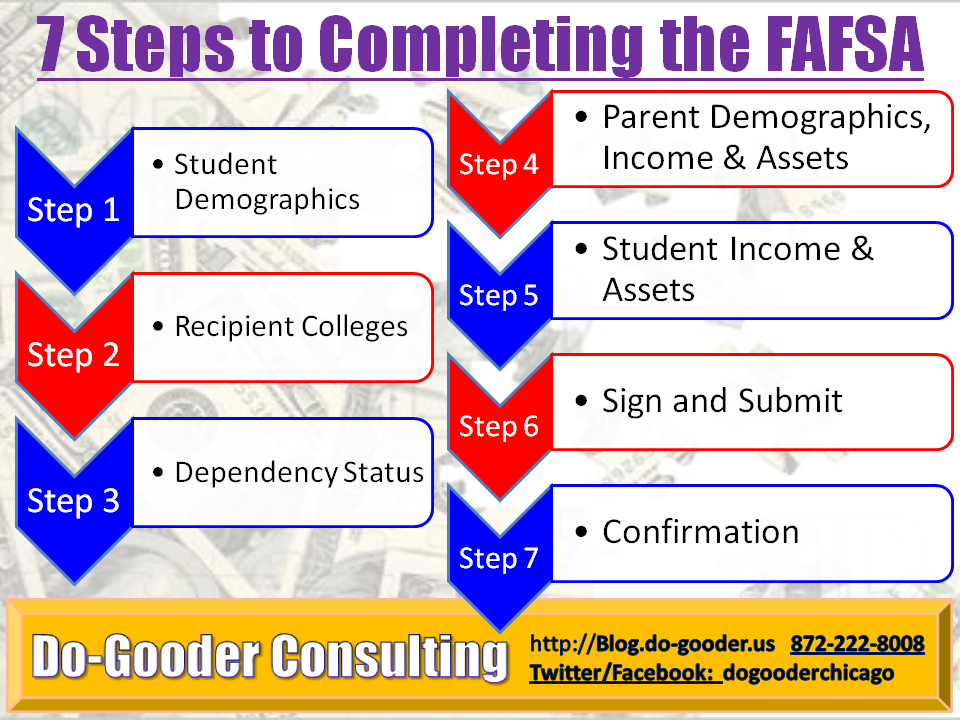
There are three items that are important to filling out the FAFSA:
1.       Social security cards
2.       W2 Forms
3.       Bank statements
The student needs the social security card, not just for the number, but also the correct spelling of the student’s name on the card. Any mistakes or variations (like a nickname) can cause serious problem. The parent, however, does not need a social security card or number, though it is helpful.

A driver’s license or state ID can also expedite the process.

W2 forms are needed from the parents (and the students, if available). Please note that providing this information does not obligate the parent to pay for any of their child’s education.  And if you (as a parent) feel you don’t make enough money to contribute anything to your child’s education – then you contribution to this section will actually help your child get more financial aid than perhaps if they filed as an independent student.

Bank statements also provide a snapshot of a family’s financial strength.

Parents who filled out the FAFSA back when they went to school need to make sure they have a shift in their mindset. In the “olden” days” of the FAFSA (back when our family filled out the FAFSA), the conventional wisdom was that you filled it out after taxes. The idea was that the paperwork was hard to update and very cumbersome, and you would need to send in copies of forms to “verify” any estimates, which would delay your financial aid. The time, and the opportunity for information to get lost, were very legitimate concerns back then.

With the modern wonders of the web, FAFSA now has a one-click tool where you can download your tax information, as long you filed electronically (such as TurboTax, or a professional service such as H&R Block).  And rather than calculate each student (and each update) by hand, the computer can easily calculate and update information, so financial aid officers actually embrace this method of estimating your FAFSA information.

Students can fill out the FAFSA anytime after January 1. So right after you say “Happy New Year!”, you can do it. Or, more likely, when you wake at 3pm in the afternoon.

This can also be a great event for churches after Sunday service. If you have access to a computer lab, one advisor can help several families through the FAFSA process.

Who should fill it out? Obviously, those going into college next year, but especially returning students, and even adults who are even just thinking about going to college. There’s no obligation to go to a specific college by filling out the form. You can easily change which colleges receive your information. And again, for parents, there is also no legal obligation to pay for the college education, even though you have given your information.


Another reason to fill out the FAFSA: colleges can not give you a financial aid package without the FAFSA being completed. You will also need to have been accepted at that college as well, because good colleges will not offer money to students they don't think will succeed at their school. 


We must emphasize once more, it is vital that students fill out the form as soon as possible, after January 1.

For example, in Illinois, the MAP grant is worth up to $4820. Again, in the “olden” days, the MAP grant money ran out by August (when most schools start their fall semester). In 2012, the money ran out March 23, which is a month before taxes are due (and usually done).

There is much more information that could be shared. But one last note to consider: the FAFSA is just a snapshot of a family’s financial situation. Colleges are aware that things happen. The key to getting exceptions to financial aid (called professional judgment) is documentation. The FAFSA is the prime example of it, but certainly not the limit. Contact your financial aid office if you think the EFC does not accurately reflect your family’s situation. 

Here are important links to see


Individuals who need help with financial aid issues should go to www.studentaid.gov or call 800-4-FED-AID (in Illinois, they can go to www.ISAC.org or call the Illinois Student Assistance Commission at 800-899-4722 ).

JP Paulus of Do-Gooder Consulting works with churches and nonprofits, and even businesses to help them integrate college access training into their programs. More information is available at www.do-gooder.us